GuideGuides·4 min read
Camping in a national park: what is allowed and what is not
Between wild camping and a proper pitch sit a handful of rules that change from state to state. The overview.
Redaktion GROUNDS·Published on August 10, 2026
In German national parks, spending the night outside a designated site is forbidden as a rule. What counts as designated is decided by each park administration, and the rules differ sharply. Three parks have set up official places to sleep outdoors. The rest have not, and the finest route in the world does not change that.
Black Forest: tent, fire ring, fifteen euros
The Black Forest national park runs trekking camps, not as a trial but as a standing offer. A night costs fifteen euros per tent. Booking runs from May to October. A camp has room for up to three tents, a fire ring and a small toilet hut, and nothing else. You bring your own water and food, and you carry your rubbish out again.
Counting the camps in the Schwarzwald Mitte/Nord and Südschwarzwald nature parks, the region has a good two dozen such places. They are all booked through the same office, and the rush starts in spring, the moment the season opens.
Hunsrück-Hochwald: three camps on platforms
The Hunsrück-Hochwald national park has three trekking camps, each with two wooden platforms and a fixed table. A platform costs fifteen euros. The season runs from 22 March to 31 October, booking is online and in advance, and one night per camp is allowed. The camps sit near the park gates at Wildenburg, Erbeskopf and Keltenpark, but away from the villages and reachable only on foot. Footpaths link them in day stages, so you can walk from one to the next.
One difference from the Black Forest stands out at once: no fire is permitted here, not even a camping stove. If you want a hot meal, you plan it differently.
Saxon Switzerland: the boofen
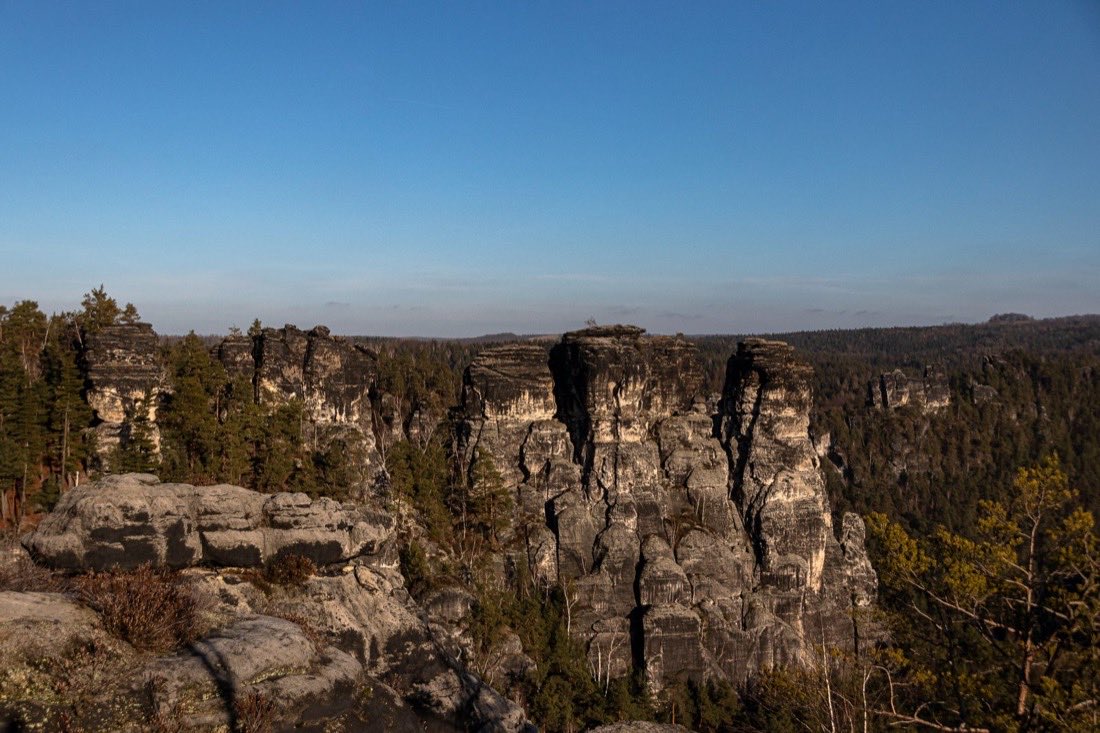
The third case is the oldest and the most idiosyncratic. In the Elbe Sandstone Mountains, sleeping under a rock overhang is called boofen, and the practice goes back well before the national park existed. Fifty-eight boofen are marked and lie outside the core zone. Anywhere else in the park, a night in the open is not allowed.
Two restrictions are worth knowing before you pack. Sleeping out is permitted from 16 June to 31 January; from 1 February to 15 June it stays closed, because sensitive species are breeding and raising their young. And it is tied to rock climbing: if you want to boof, you climb. Fire is forbidden, candles and stoves included. Rubbish comes back out with you, food scraps and tissues included.
Where it is expressly not possible
The Wildnis-Trail through the Eifel national park runs four stages and eighty-five kilometres through the park, and it is a good illustration that a multi-day route does not come with permission to pitch a tent. You sleep in the villages at the end of each stage. Camping on the trail is not allowed, and neither is sleeping in a camper.
The same applies to the remaining national parks. Anyone travelling in the Bavarian Forest, the Harz, around the Müritz or on Jasmund looks for a place outside the park boundary.
Just outside, it gets easier
Beyond the national parks, a great deal has changed in recent years. More than two hundred bivouac and trekking sites now exist across the country, most of them in nature parks and state forests. The Hohes Venn-Eifel nature park has eighteen, the Sauerland trekking park thirteen along the Diemelsteig and Uplandsteig, and the Palatinate Forest around fifteen. Schleswig-Holstein runs close to twenty sites under the name Wildes Schleswig-Holstein, open to walkers and cyclists and free of charge, though a donation is sometimes invited.
The pattern is much the same everywhere: one night per site, arrival on foot or by bike, booking in advance, coordinates after confirmation. The range runs from nothing to fifteen euros, and the price is for the pitch, not for the person.
And the camper?
A single night at the roadside or in a public car park is permissible if it serves to restore your fitness to drive. Roughly ten hours is the accepted figure. It appears in no statute, but it has settled in with police and local authorities. Arrive in the evening, sleep, drive on in the morning: that is the idea.
The tolerated night turns into a special use requiring permission the moment it starts to look like a stay. So the awning stays in and the camping chair stays in the boot. Using the kitchen and the bathroom inside the vehicle is not affected.
The easy way
All of these arrangements have one thing in common: they are made for people who arrive on foot or by bike and move on the next morning. Anyone arriving with a vehicle and luggage, planning to stay a few days, will find sites around the national parks made for exactly that. Many lie close enough to the boundary that the walk into the forest starts at the pitch.
