Rent a yurt
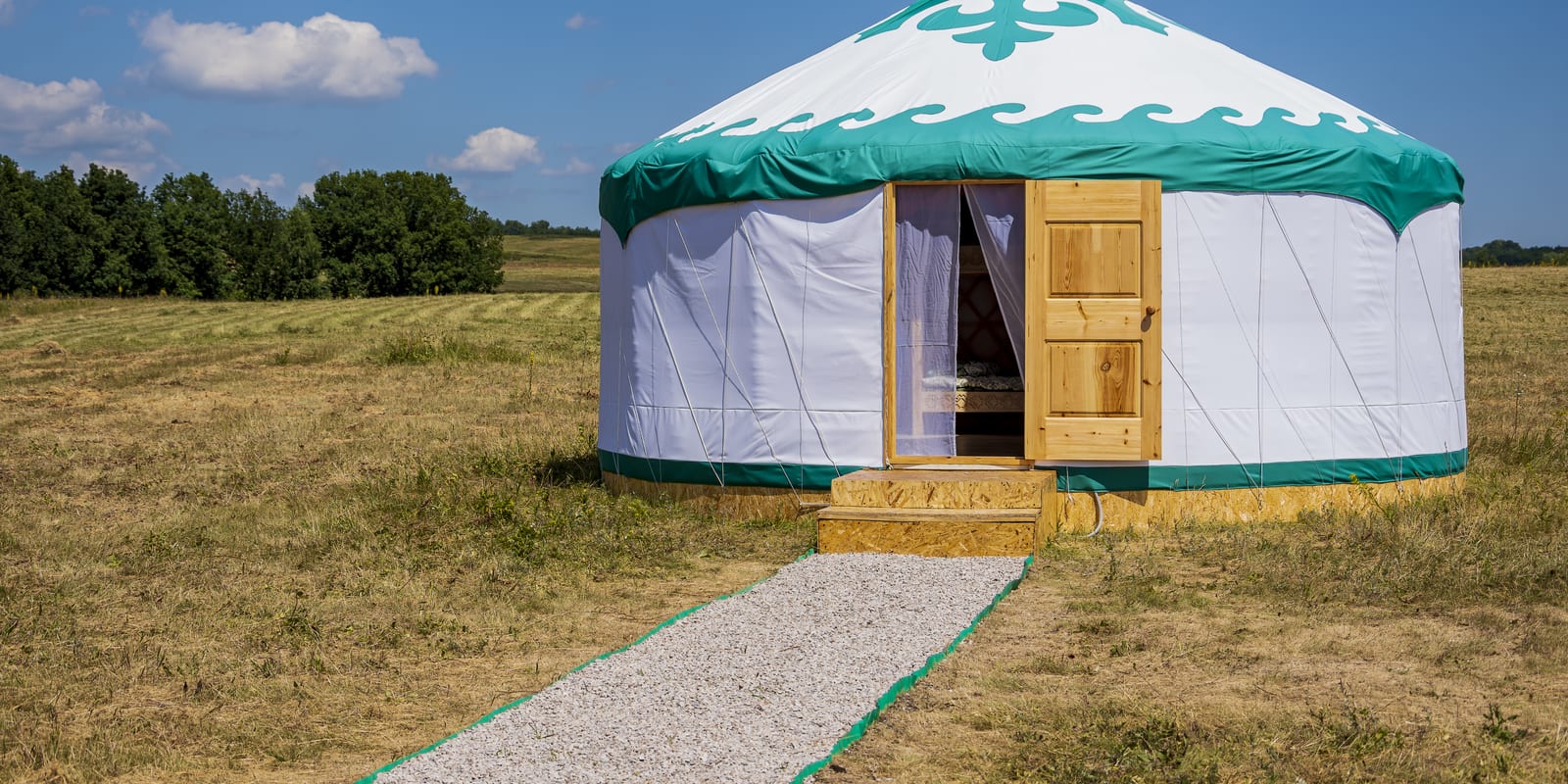
A yurt is a round tent on a wooden frame. A lattice wall carries the roof poles, which meet in a ring above the middle, and felt and canvas go over the top. The whole thing is held together with bands and ropes. Inside it is one room without corners, and full height is under the crown, not at the wall. The shape is what separates it from a tipi: a tipi tapers to a point, a yurt has an upright wall with a shallow roof above it. The Mongolian build uses straight roof poles, the Kyrgyz and Kazakh ones bent poles, which makes the roof higher and rounder.
What to check before booking
- How is it heated?
- Many yurts have a small wood stove with its pipe running out through the roof. It warms quickly and cools just as quickly once nobody adds a log at night. Other hosts heat electrically, and some yurts stand only in summer.
- What is under the floor?
- Some yurts stand on a wooden deck, others straight on the grass. Whether the floor is insulated shows up on a cool night more clearly than the wall does. It is rarely in the description and easy enough to ask about.
- How is the crown closed?
- A ring sits above the middle, left open in the classic build and pulled shut with a cover on a rope. Many yurts built in Europe have a fixed dome of glass or plastic there instead. One version opens to the night sky, the other stays tight in rain and lets the morning in early.
- What is it covered with?
- The traditional yurt carries felt of sheep or goat wool under an outer skin. Yurts built in Europe often work with cotton or tent fabric and are made for more rain. Both are called a yurt, and they keep you warm differently.
- Where is the bathroom?
- If the yurt stands on a campsite, the sanitary building usually comes with it. On private ground there is sometimes a bathroom of its own in an annexe, sometimes a dry toilet a little further off. Anyone who dislikes going outside at night checks first.
Who it suits
Made for
Couples and families who want to sleep somewhere different without pitching a tent for it. If you want the weather and the light close by and still need a solid roof, this is the right shape. It works for small groups too, because a round room seats everyone around one middle.
Less so for
Anyone who needs to get away from the others will not manage it in a yurt, because there is one room and no door between. More gets in from outside than in a house, since wall and roof are fabric over a wooden frame. And a yurt is rarely step free, because the door is small and has a threshold, often with a step up from the ground on top of that.
Where it comes from
The yurt is older than any record of it. Feltmaking and round tents grew up among the herding peoples of the Eurasian steppe, and archaeological traces reach back to the late Bronze Age. An early and careful description comes from the Franciscan John of Plano Carpini, who travelled to the Mongols from 1245 to 1247 and wrote of round felt dwellings with a smoke opening in the middle. His fellow friar William of Rubruck saw felt houses from 1253 to 1255, some of them standing on carts. The craft is on the UNESCO list of intangible cultural heritage, since 2013 for the Mongol ger and since 2014 for the yurt of the Turkic nomads.
Good to know
The stove needs somebody
Where a wood stove stands, it keeps the yurt warm as long as somebody adds a log. Overnight it goes out, and by morning it is noticeably cooler inside.
You hear the rain well
Felt and canvas muffle little. A shower on the roof is clearly audible, and in return you know the weather in the morning without looking out.
Daylight comes early
Where the crown is glazed or open, light comes in long before the alarm goes off. If that bothers you, bring something for your eyes.
