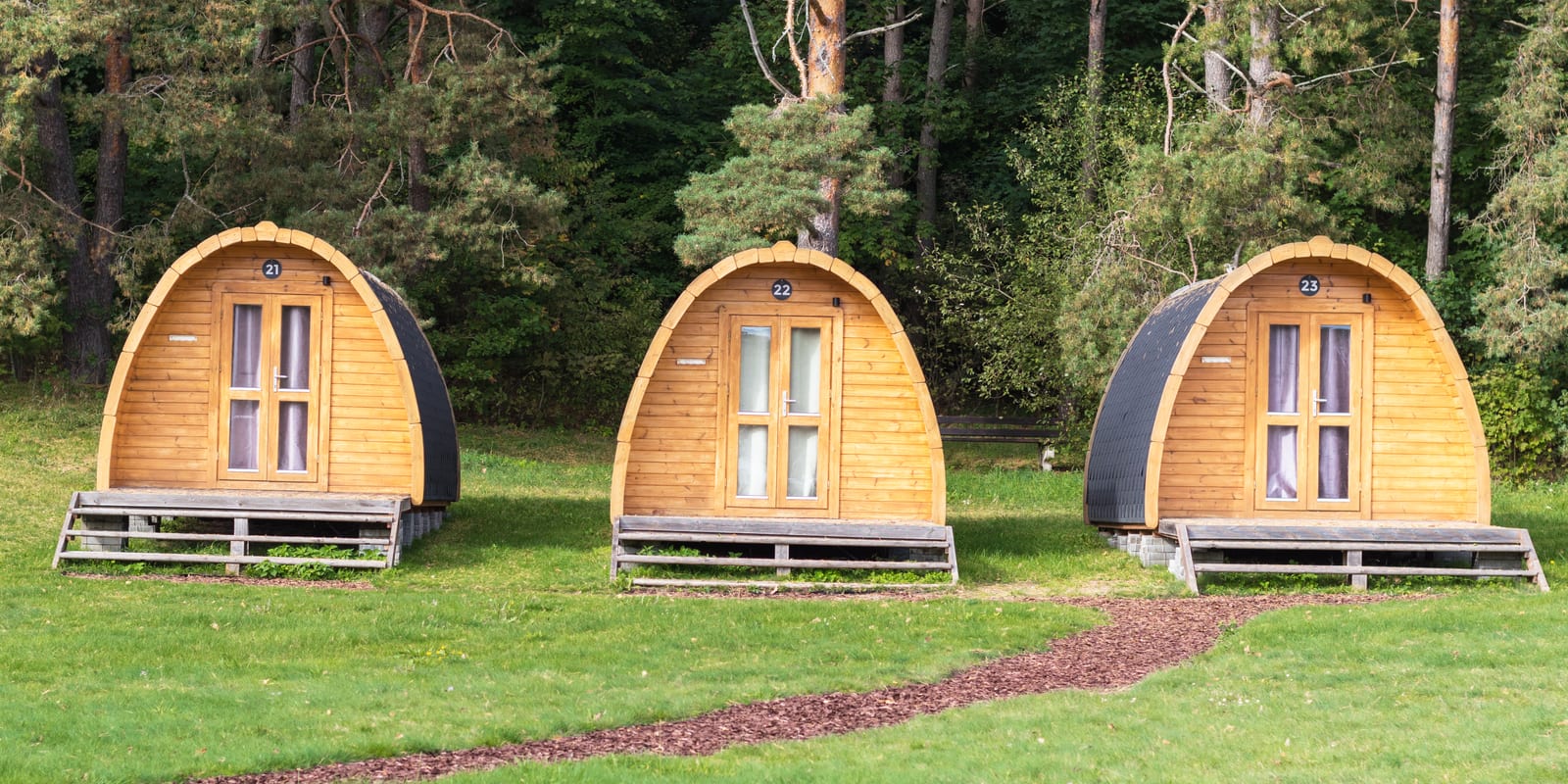
Rent a camping pod
A camping pod is a small timber cabin that stands on a campsite. The best known shape has a roof curving down to the ground, and there are also pods with a pointed roof in the style of a Finnish hut. A small terrace usually sits in front of the door. Against a tent a pod is insulated and lockable, and when it rains everything inside stays dry; against a chalet or a mobile home it is much smaller and often a single room. What you find inside varies widely. Some pods have a kitchen unit and a bathroom of their own, others are a warm room with beds and a socket.
What to check before booking
- Is there a bathroom inside?
- Some pods have a shower and a toilet, with others you walk to the sanitary building of the site. Both are common, and the listing says which applies. Anyone who would rather not cross the site at night checks first.
- Is it heated, and is there power?
- Most pods are insulated and have sockets, but not all of them have heating. That decides whether spring and autumn are still an option.
- Do you bring your own bedding?
- At one site the linen is included, at the next you find only a mattress and a pillow and the sleeping bag comes from home. Renting it on the spot is often possible.
- Where do you cook?
- Anything from a kitchen unit with a fridge to nothing at all. Without a kitchen on board you cook outside on your own stove or use what the site offers.
- How does the roof run?
- With both shapes the wall slopes down towards the floor. In the middle you stand upright, at the sides it gets low. The photographs show clearly how much space is left above the bed.
Who it suits
Made for
Anyone who wants to stay on a campsite without owning a tent, a caravan or a camper. Families with small children get by with little luggage, and walkers arriving on foot find a solid roof in the evening. The threshold is low.
Less so for
Space and privacy are not on offer. Usually everyone sleeps in one room, and two people staying for two weeks will find it tight. Without a bathroom on board, the walk to the sanitary building belongs to every day.
Where it comes from
The design comes from Scotland. Charles Gulland built small huts there in the nineties out of forest thinnings, mostly larch, and put the first ones along the West Highland Way so that walkers could sleep dry. He called them wigwams. In Britain they grew into a category of their own under the name pod, and today such huts stand on sites in Germany, the Netherlands and Switzerland as well.
Good to know
Dogs not everywhere
A pod often follows a different rule than the pitch next to it. Some hosts take dogs in, others keep their rental units free of them.
Open flame stays outside
A timber cabin takes neither candles nor a barbecue indoors. Where a fire is allowed and where it is not is set by the site rules.
Arriving without a vehicle of your own
A pod stands on a pitch like a tent or a caravan, only it belongs to the site. You come by car, by bike or on foot and still have a solid roof.
