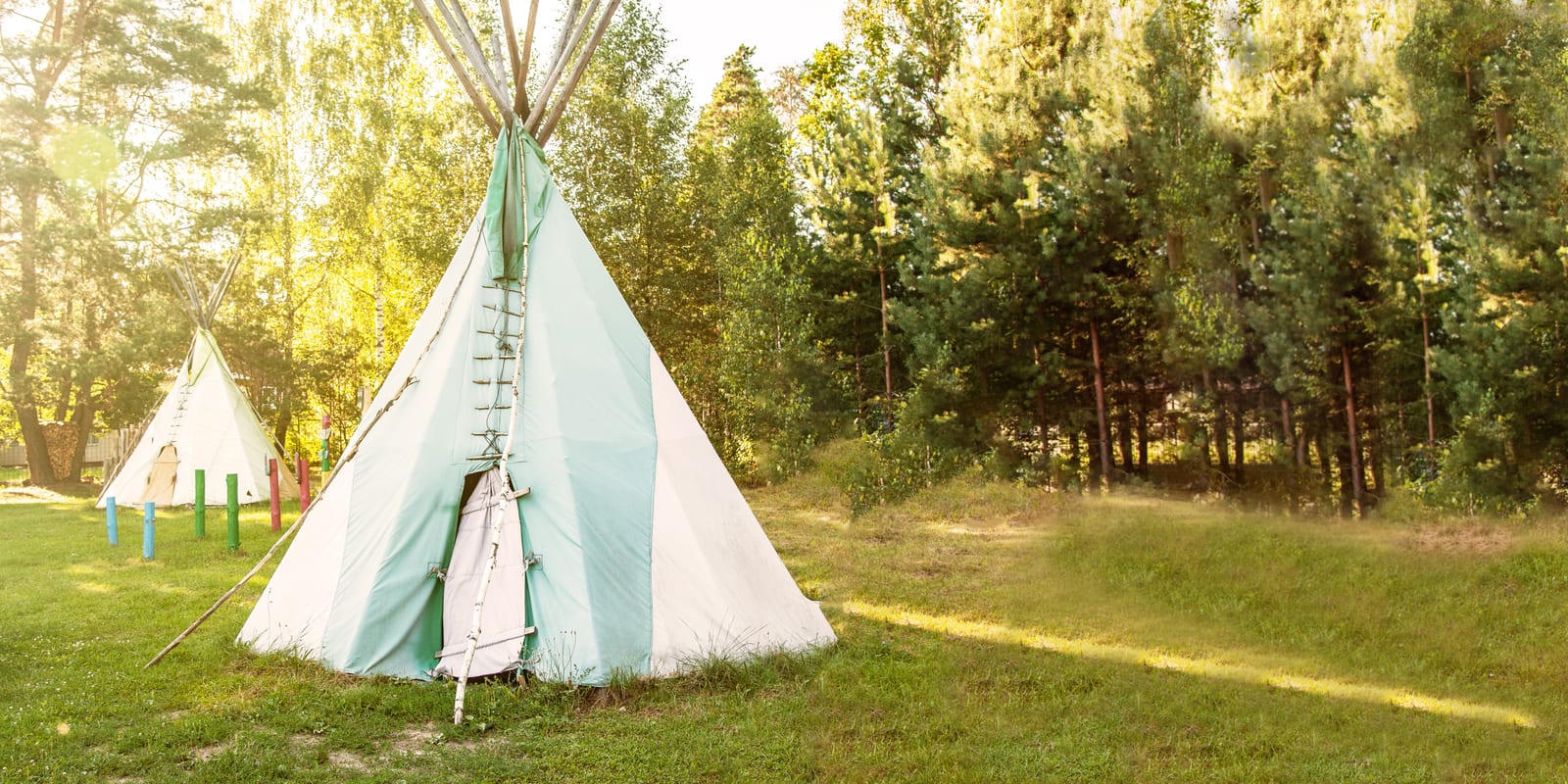
Rent a tipi
A tipi is a conical tent of long poles with a cover over them. Two movable smoke flaps sit at the top. They are what separates a tipi from other conical tents, because they let the smoke of a fire out and still keep rain off. In the classic build the poles cross below the apex and stick out a little above it, which gives the familiar outline. Inside, the wall leans towards the middle from every side, so you stand upright in the middle. A yurt beside it has an upright wall and a roof of its own; a tipi runs in one line from the ground to the point.
What to check before booking
- Is a fire allowed inside?
- The tipi is built for it, which does not mean it is permitted. Some hosts put a fire bowl in and leave wood beside it, others rule out any open fire in the tent. Wood you bring yourself is off limits on some sites.
- What do you sleep on?
- There are tipis with a wooden floor and beds, and tipis where mattresses lie on a groundsheet. That decides what you have to bring, from a sleeping bag to a mat. The description usually spells it out.
- Is there a liner?
- Many tipis have a second sheet running around the poles on the inside and reaching part way up. It keeps the draught off at floor level and sends water that runs down the poles behind it. Without one, the wall side is draughtier.
- Where is the bathroom?
- Tipis almost always stand on a site or a farm, and the bathroom is in the sanitary building. How far away it is makes the difference at night. A bathroom inside the tent is the exception.
- How long is the season?
- A canvas cover insulates hardly at all, so most hosts let their tipis in the warm months. In spring and autumn the nights turn far cooler than they would in a solid house. If you book off season, ask about heating and blankets.
Who it suits
Made for
Families with children for whom the night in a tipi is the actual reason for the trip. Groups get on with it too, because there is plenty of room on the floor and little at the wall. If you like camping but not pitching, this is the short way between the two.
Less so for
If you feel the cold or sleep lightly, a canvas tent is harder work than a house. A tipi does not usually lock, so valuables are better off in the car. And if you would rather not stoop through a low door flap and cross a meadow on foot, you will be happier somewhere else.
Where it comes from
Conical hide dwellings stood on the plains of North America long before Europeans arrived. The tipi only grew large with the horse: as long as dogs dragged the poles on a travois the tents stayed small, and after that longer poles and heavier covers could be moved. Covers were made of buffalo hide, and through the nineteenth century increasingly of canvas, which was lighter and could be cut to shape more cleanly. The word comes from Lakota, where thipi means roughly they dwell there.
Good to know
The fire is the host's call
Smoke flaps belong to the design, permission to light a fire does not. Whether and where you may burn is each site's own rule, and in dry summers official bans come on top.
The weather is close
Over your head there is one width of fabric and nothing else. You hear a thunderstorm from the first second, and wet clothes dry slowly in a tent.
Dogs by arrangement
Many sites take dogs, but for the tipi itself the host decides. A look at the house rules before booking saves the discussion on arrival.
