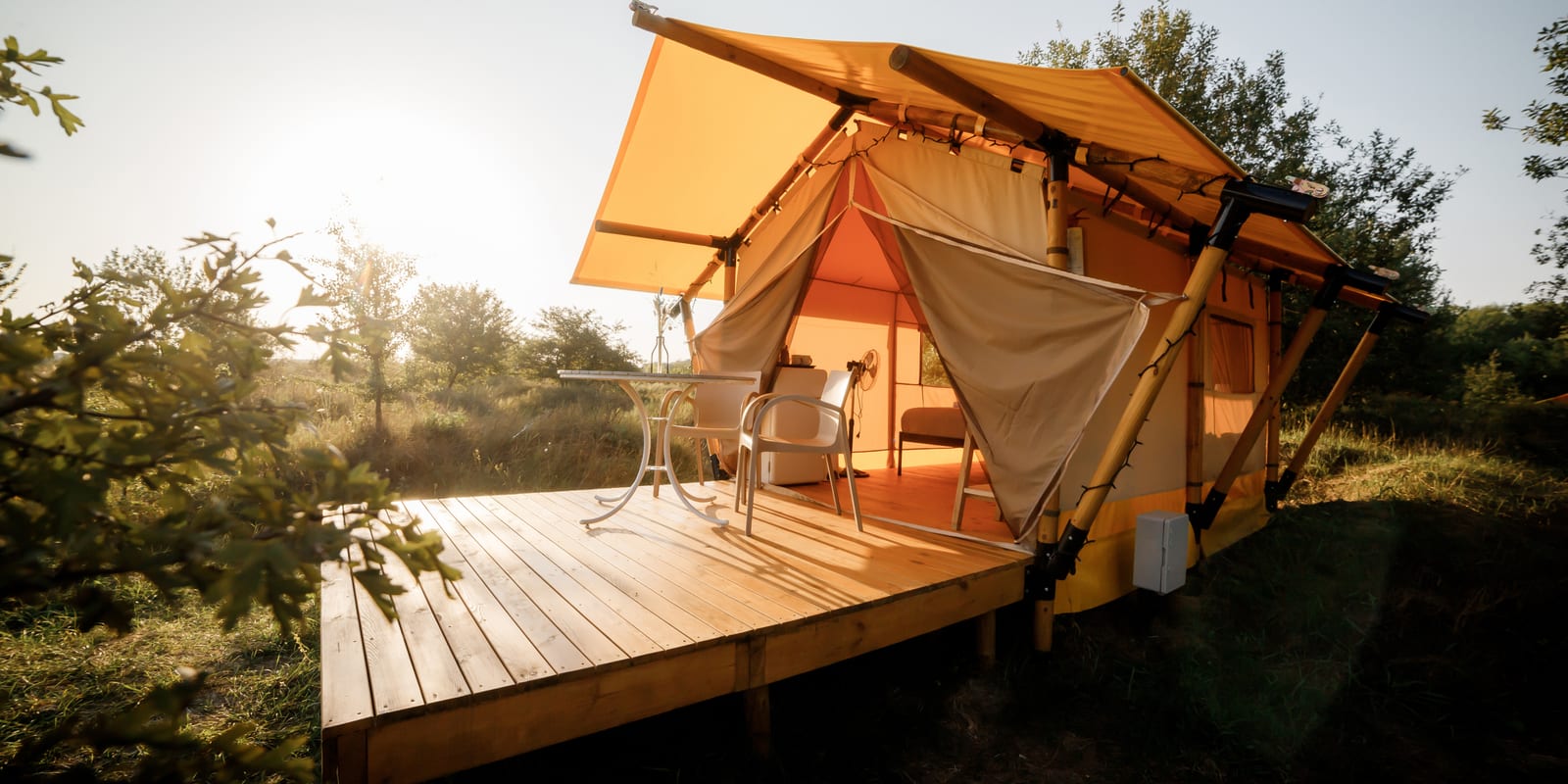
Rent a safari tent
A safari tent is a rental unit of canvas stretched over a wooden frame. It stays in the same spot for the whole season, usually on a wooden deck with a veranda in front. From outside you recognise it by the high ridge and the straight side walls. Inside, beds are set up and the sleeping areas partitioned off, often with somewhere to cook as well. The difference from a mobile home lies in the skin: canvas does not insulate, and you hear the site. You sleep closer to the weather than in a solid building, and still in a real bed.
What to check before booking
- Is there a bathroom in the tent?
- Some safari tents have a shower and a toilet on board, others belong to the sanitary building of the site. Both are common. Anyone who dislikes crossing the site at night checks first.
- Is there a kitchen and running water?
- Everything exists, from a kitchen unit with a sink to a tent meant only for sleeping. Where there is no connection, a canister is often set out, and you do the washing-up in the site's sanitary block.
- From when to when does the tent stand?
- Most sites rent safari tents only through the warm half of the year, and some take them down in autumn. That leaves fewer bookable weeks than a solid building has. Anyone travelling in spring or autumn checks the dates first.
- How are the sleeping areas divided?
- Some tents have a wooden wall between the compartments, others a hanging cloth. Neither one locks. The photographs usually show it better than the text.
- Is it heated?
- Many safari tents have no heating, a few have a stove or an electric solution. On a clear night canvas cools down faster than masonry. Anyone who feels the cold asks before booking.
- What is provided, what do you bring?
- Pillows and blankets are often there, bed linen and towels almost never. Some hosts lend both for a fee. A look at the description settles it.
Who it suits
Made for
Families and friends who want to camp together without hauling equipment. You bring very little. Anyone who likes tents but no longer wants to lie on a mat gets both here, and for a first camping holiday with children it is a gentle start.
Less so for
Canvas walls hold back little sound, in either direction. Anyone who needs quiet or feels the cold quickly is better off in a solid building. A safari tent is rarely step free, because there is almost always a step up to the deck.
Where it comes from
Safari is Swahili and means journey. The big hunting expeditions in British East Africa moved through the country with whole tent camps; the expedition Theodore Roosevelt set out on for the Smithsonian in 1909 had its own tent men, gun bearers and around 250 local porters. Camps like those later became the fixed tented camp with a wooden floor and a bed. On European campsites the safari tent has only been a rental unit since the 2000s.
Good to know
Fire only where it belongs
Canvas and embers do not go together. The barbecue and the fire bowl belong where the site allows them, not on the veranda.
You hear the rain
On canvas every shower sounds louder than it does under a roof. Light sleepers do better expecting it.
Register the dog first
Many hosts take a dog in a safari tent, some for a fee, some not at all. Settle it before you book.
