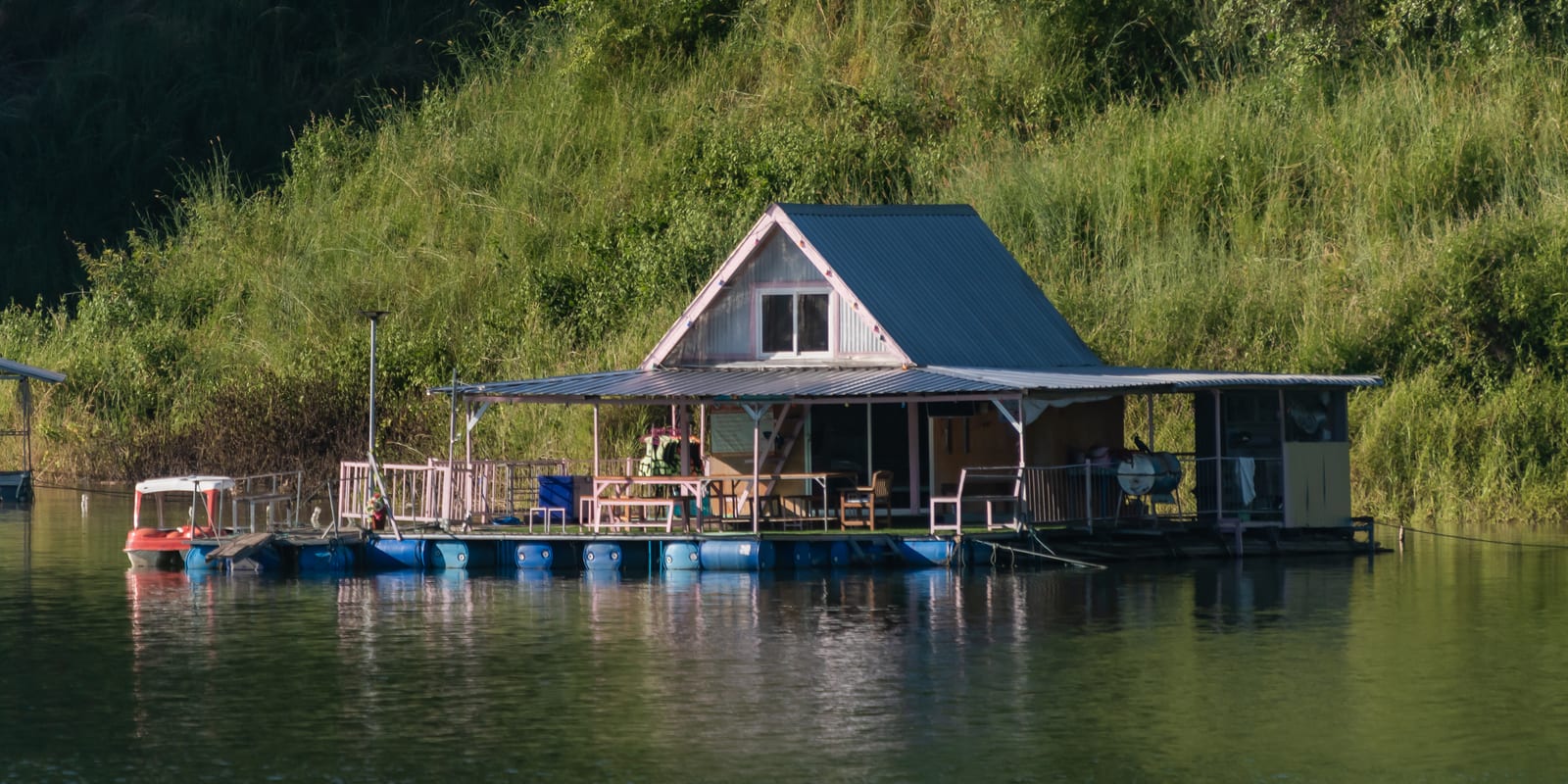
Rent a houseboat
A houseboat is a place to stay on the water, reached across a jetty. One word covers two kinds of build: one lies fixed at its mooring and never moves, the other has an engine and is steered by the guest. Inside it looks like a small holiday home, except that the windows sit just above the waterline. The floor moves when a boat passes. Against a holiday flat on the bank, the water here starts at the door.
What to check before booking
- Moored or under way?
- This is the biggest split inside the type. A fixed houseboat is booked like a holiday home at a jetty. A moving one is handed over like a hire vehicle, with a briefing and a return.
- Do you need a boat licence?
- On designated waterways in several German states, no. Since May 2000 there has been the charter certificate: the operator gives at least three hours of instruction and issues a paper valid only for the hire period and only for that water. Boats under the scheme may be no longer than fifteen metres.
- Where is the mooring, and where is the car?
- A berth in a marina is a different thing from a jetty at the edge of a wood. Whether parking comes with it, and how far the luggage travels along the pontoon, is rarely in the headline.
- How tall may the boat be?
- Anyone who travels passes under bridges, and on most waters through locks as well. Clearances differ from one stretch of water to the next, and the operator will say which circuits his boat can do.
- How do water and the toilet work?
- Fresh water comes from a tank on board or from a connection at the jetty. Waste stays in a holding tank and is pumped out at a station, it may not go into the water. On a moving boat both belong in the route planning.
Who it suits
Made for
Anyone who likes living by the water and wants to look at it first thing in the morning. A moving boat suits groups who want to travel together and trust themselves at the wheel. A fixed one suits everyone who wants the position without planning stages.
Less so for
Anyone who cannot swim, or who has very small children along, is watching all the time on board. A houseboat is rarely step free, because the jetty and the way aboard almost always mean steps. And anyone who wants to operate nothing on holiday should leave the moving boats alone.
Where it comes from
Living on the water is a Dutch habit above all in Europe. Towards the end of the nineteenth century steel vessels pushed the wooden sailing barges out of inland shipping, and private buyers took the retired hulls and converted them into homes. In 1918 the Dutch state passed a law of its own on caravans and houseboats that required every municipality on the water to provide at least one mooring, and in the years that followed the housing shortage pushed their numbers up sharply. Hundreds still lie in the canals of Amsterdam.
Good to know
Life jackets for children
The step from the jetty into the water is a short one. Where children are aboard, a jacket belongs on deck, even when the boat never moves.
Bridges and locks
Anyone steering plans the circuit around clearances and lock passages. The operator knows his water and will say what fits into a week.
Dogs on board
Many operators take dogs, some do not. On the jetty and at locks the dog is better on a lead.
Grilling by arrangement
An open flame on a boat is a delicate thing, and harbours have rules of their own. Anyone who wants to grill settles it before booking.
