Rent a glamping dome
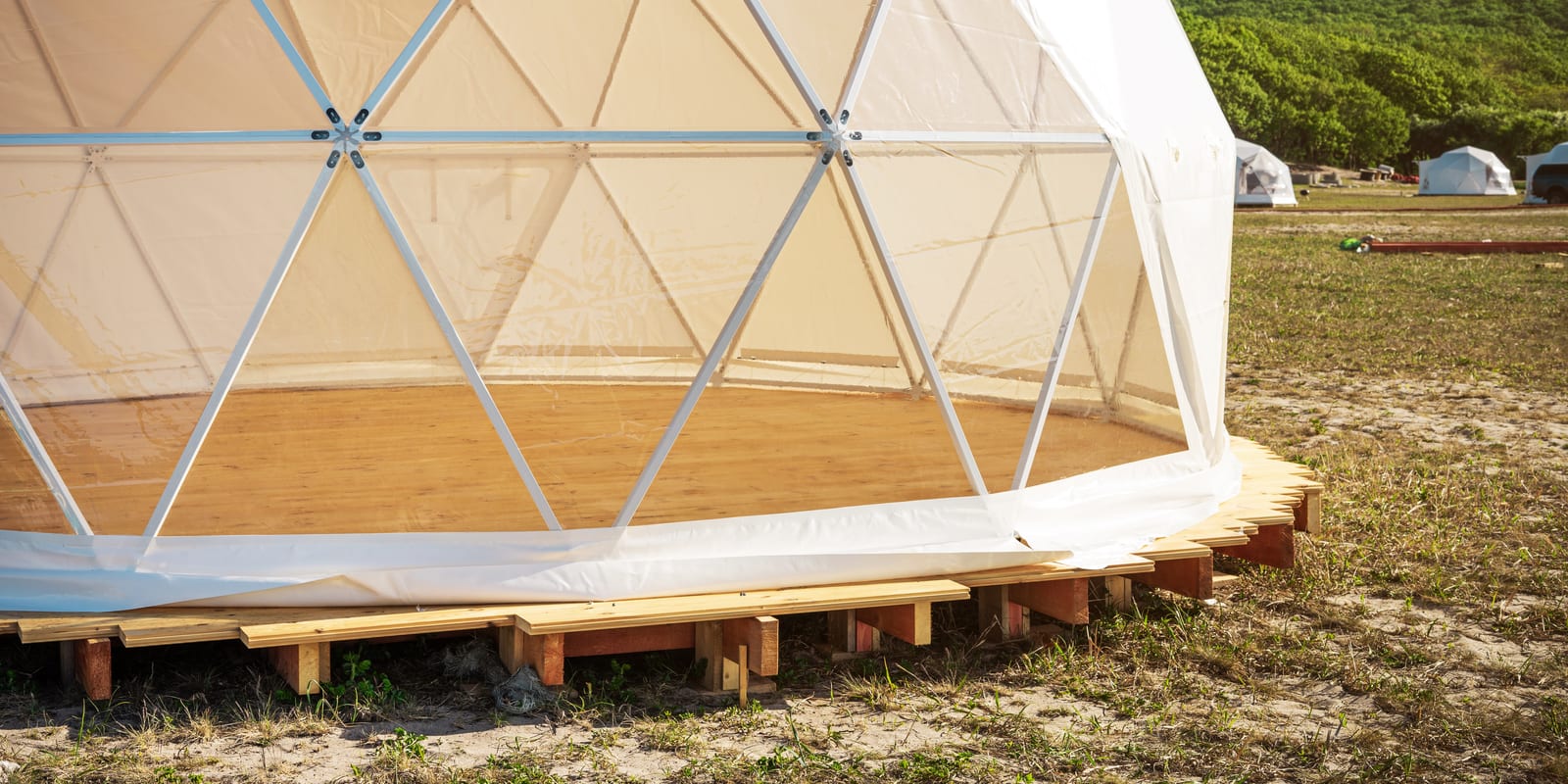
A glamping dome is a shell of triangles with a membrane stretched over it. The frame carries itself, so nothing stands in the middle of the room. The dome usually sits on a wooden deck, and a large window opens the view outwards. The form is what separates it from a yurt: a yurt has an upright wall and a conical roof, while a dome curves from the ground up. The centre is high and the rim is low. Whether it can be booked in winter depends on insulation and heating.
What to check before booking
- How much of the circle can you use?
- The wall curves inwards, so there is little room at the rim. Beds and seating move closer to the middle than they would in a square room. The photographs show how the hosts have solved it.
- Is there a panorama window, and can it be darkened?
- Many domes have a large window, some a second one in the roof. That is the reason people book a dome and also the reason it gets light early. Curtains or blackout are not part of every one.
- Where are the bathroom and the kitchen?
- Some domes have both on board, others stand without a water connection and use the buildings of the site. Both exist. The description says which of the two you are booking.
- Is it insulated and heated?
- A membrane on its own holds no warmth. Anyone booking outside the summer looks for an inner liner and for a stove or heating. Without it, most domes close over the winter.
- How does the air move?
- Sun on a dome with a large window warms the inside quickly. Vent openings and a window that really opens make the difference on a hot day. Some domes have a fan as well.
Who it suits
Made for
Anyone looking for one night with a view, who likes to watch the sky in the evening, is in the right place. Where the dome stands on its own, the glazed surface becomes the real reason to book. For a short break it works well.
Less so for
Anyone who needs cupboards and storage will find little of it in a round room. With a lot of luggage or over a full week it gets tight. And anyone who needs darkness in the morning asks about the blackout first.
Where it comes from
The first geodesic dome went up in Jena in the 1920s. Walther Bauersfeld built it at Carl Zeiss as the shell for the first projection planetarium, at first on the roof of the works. Richard Buckminster Fuller developed the method further from the end of the forties, introduced the word geodesic for it and had it patented in the United States in 1954. Because the triangles spread the load across the whole shell, the form needs no column inside, and that is what makes it usable as a place to sleep.
Good to know
Rain on the membrane
Rain carries well on a stretched skin. Where an insulated inner liner has been fitted, little of it is left. Light sleepers should read up on the amenities beforehand.
Morning arrives early
Where the window faces east, the sun wakes you before the alarm. An eye mask weighs nothing.
Stove and open fire
Where a stove stands inside the dome, the host explains it on arrival. The barbecue and the fire bowl keep the distance the site sets.
